


Choosing between Additional Mathematics (A-Math) and Elementary Mathematics (E-Math) is an important decision for many secondary school students. Both subjects are part of the O-Level curriculum, yet they differ significantly in difficulty, content, and purpose. Understanding these differences can help students make informed subject choices and prepare better for future academic pathways.
If you are a Sec 2 student deciding whether to take A-Math, or a student currently struggling with Math, this guide will clearly explain the differences and help you decide which path suits you best.
What is E-Math (Elementary Mathematics)?

Purpose of E-Math
E-Math is the foundational mathematics subject taken by almost all secondary school students. It focuses on practical math skills used in daily life and builds a strong base for further studies.
Key Topics in E-Math
Students typically learn:
- Arithmetic and basic algebra
- Percentages, ratio, and proportion
- Geometry and mensuration
- Statistics and probability
- Graphs and linear equations
These topics emphasise real-world applications, making E-Math more practical and relatable.
Difficulty Level of E-Math
E-Math is generally manageable for most students with consistent practice. Success depends on understanding concepts clearly and applying them accurately during exams.
What is E-Math (Elementary Mathematics)?

Purpose of A-Math
A-Math is designed for students who are stronger in mathematics and may pursue science, engineering, or JC pathways. It introduces more abstract mathematical thinking and prepares students for advanced math in upper education.
Key Topics in A-Math
TStudents will encounter:
- Advanced algebra and algebraic manipulation
- Quadratic equations and functions
- Logarithms and indices
- Trigonometry
- Differentiation and integration (introductory calculus)
These topics are more theoretical and require deeper understanding.
Difficulty Level of A-Math
A-Math is widely considered more challenging than E-Math. It requires:
- Strong algebra foundation
- Logical thinking and problem-solving skills
- Consistent practice and concept mastery
However, with the right guidance and practice, many students improve significantly over time.s.
A-Math vs E-Math – Key Differences

Difficulty Comparison
A-Math is more complex and concept-driven, while E-Math is more practical and application-based.
Topics & Content Depth
A-Math covers advanced algebra, trigonometry, and calculus.
E-Math focuses on foundational math and real-world applications.
Study Time & Effort Required
- A-Math usually requires more practice and revision.
- E-Math is easier to maintain with consistent understanding and practice.
Exam Style
- A-Math exams are problem-solving heavy and require clear working steps.
- E-Math exams include structured and application-based questions.
Future Academic Pathways
- A-Math is a prerequisite for JC H2 Math
- E-Math is sufficient for most diploma courses and general academic pathways.
Should You Take A-Math?
Suitable Students for A-Math
You may consider A-Math if you:
- Are strong in algebra and problem solving
- Enjoy mathematics and logical thinking
- Are willing to practise consistently
When A-Math May Not Be Necessary
A-Math may not be essential if:
- You struggle with basic algebra concepts
- You prefer humanities, arts, or business pathways
- You are already overwhelmed with multiple subjects
Choosing wisely based on your strengths and goals is important.
Can You Take Both A-Math and E-Math?
Yes. In fact, most students take both subjects together. E-Math builds foundational skills, while A-Math deepens mathematical thinking. When studied together, they complement each other and strengthen overall math ability.
Why Many Students Struggle with A-Math and E-Math
Math difficulties are common, and most struggles come from:
- Weak algebra foundation
- Lack of conceptual understanding
- Poor exam techniques and time management
- Insufficient practice
- Fear or loss of confidence in math
The good news is that these challenges can be overcome with the right learning approach and support.
How the Right Guidance Can Improve Math Results

Strong Fundamentals Matter
Many math problems stem from weak basics. Building a solid algebra and concept foundation makes advanced topics much easier.
Personalised Learning Approach
Every student has different strengths and weaknesses. Targeted guidance helps students close learning gaps and improve faster.
Exam Strategies & Question Analysis
Understanding exam patterns, common mistakes, and answering techniques can significantly improve scores and confidence.
How Advo Education Helps Students Excel in A-Math & E-Math

At Advo Education, students receive structured and supportive math guidance designed to improve both understanding and exam performance.
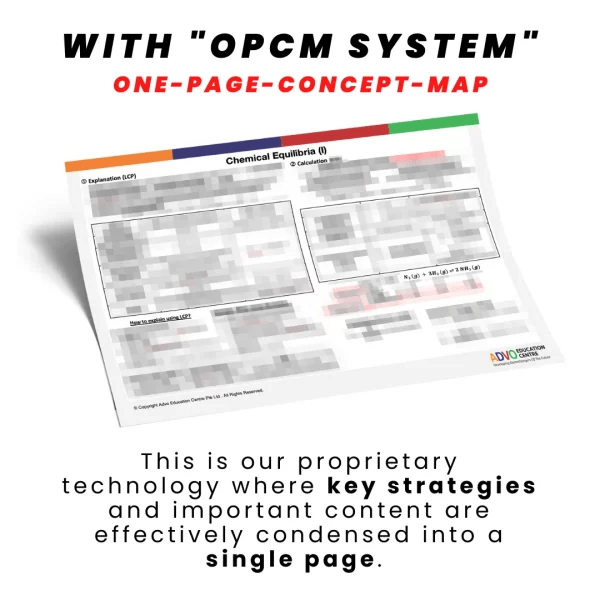
Our OPCM™ (One Page Concept Map) Method helps students simplify complex topics by organising key concepts, formulas, and strategies into a single A4 sheet. This clear structure makes it easier for students to understand connections between concepts and solve exam questions with confidence.
With the right guidance, many students gain confidence, improve grades, and develop a stronger understanding of mathematics.
Choosing the Right Math Path
Both A-Math and E-Math are valuable subjects, and each serves a different purpose. E-Math builds essential mathematical skills, while A-Math prepares students for advanced academic pathways. The right choice depends on your strengths, interests, and future goals.
If you are currently struggling with Math, remember that improvement is always possible with the right support, consistent practice, and proper guidance. Building confidence early can make a big difference in your academic journey.